
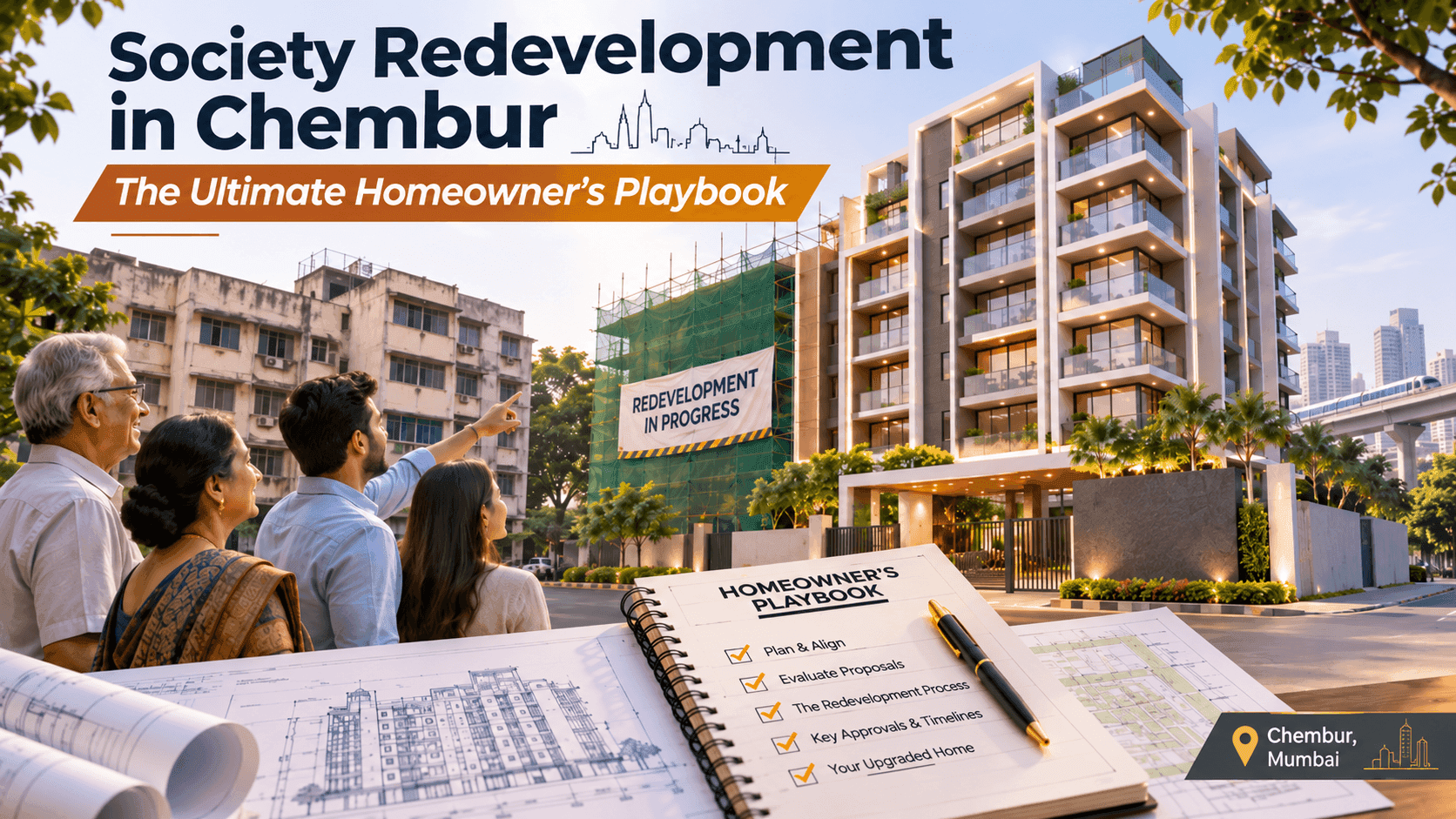
Society Redevelopment in Chembur: The Ultimate Homeowner’s Playbook
Society redevelopment in Chembur follows four phases: feasibility, developer selection, legal and financial agreements, and construction through handover. Skip or rush any one phase and your society absorbs the risk. Get them right and members move into larger, safer flats with a corpus fund behind them.
Ageing buildings in Collector’s Colony, Sindhi Society, Swastik Park and across Chembur East and West are showing cracked slabs, leaking terraces and corroded rebar. Redevelopment is now a question of when, not if. The legal framework is dense, though. This playbook gives your managing committee the exact sequence to follow, built on over a decade of engineering-led, transparent delivery in Chembur.
Phase 1: Pre-Redevelopment and Feasibility
Form a Redevelopment Committee You Can Trust
Start with people, not paperwork. Elect a small committee of respected members, ideally including someone with legal, engineering or finance experience. Keep every meeting minuted.
Then call a general body meeting. The resolution to explore redevelopment must pass with the majority your bye-laws and current Maharashtra government resolutions require. Have your legal advisor confirm the threshold before you vote. A defective resolution can unravel the project two years later.
Commission an Independent Structural Audit
Hire a structural engineer who is government-certified and has no link to any builder. The audit decides how urgent your case is. MCGM classifies buildings like this:
- C1: Dangerous. Must be vacated and demolished.
- C2A: Structurally unsafe. Needs vacating for major repairs.
- C2B: Needs major repairs, but members can often stay.
- C3: Minor repairs only.
Next, calculate your real potential. Mumbai projects run under DCPR 2034, the city-specific counterpart to UDCPR. Have a qualified architect work out the permissible built-up area, available FSI and the TDR you can load. Without these numbers you cannot judge whether a developer’s offer is generous or stingy.
Phase 2: Choose Your Developer Through a Transparent Process
Draft a Tender Document That Protects You
Put your demands on paper before any builder speaks to you. Specify:
- The carpet area each member expects
- Minimum corpus fund per member
- Monthly transit rent and shifting allowance
- Parking, security, fire safety and power backup
A clear tender forces developers to compete on your terms rather than theirs.
Invite Expressions of Interest and Shortlist
Publish a notice in newspapers and on digital portals. Then screen ruthlessly. Ask each developer for:
- Completed projects in Chembur and wider Mumbai, with visits to occupied buildings
- Audited financials and net worth
- Proof of full Occupation Certificate (OC) delivery, not just part-OC
- Pending litigation and MahaRERA complaint history
Walk through a finished project and talk to the residents. Their answers beat any brochure.
Compare Proposals Line by Line
Carpet area enhancements commonly land between 20% and 35% over existing area. Treat any number outside local market viability with suspicion. A 50% promise on a small plot usually means a broken promise later.
Examine the bank guarantee and the earnest money deposit (EMD). How much is it, who holds it, and when does it release? A strong developer parks real money where the society can see it.
Phase 3: Legal, Financial and Agreement Frameworks
Hire Your Own Legal Advisor
The developer’s lawyer works for the developer. Your society needs its own counsel, one who has drafted and vetted redevelopment agreements, and who can read the fine print on title, encumbrances and approvals. This is the best money your society will spend.
Negotiate These Financial Clauses
Transit rent. Monthly rent must be backed by a bank guarantee or escrow account. Add an annual escalation clause and a penalty for delay. Without them, members pay Chembur rents out of pocket when the project slips.
Corpus fund. This one-time lump sum per member cushions future maintenance in the new building. Fix the amount in the agreement and the date it is paid.
Shifting charges and brokerage support. Moving twice, out and back in, costs real money. Insist on a fixed shifting allowance for both trips and a brokerage contribution for finding rental housing.
Execute the DA and PAAA
The Development Agreement (DA) and the Permanent Alternate Accommodation Agreement (PAAA) are the two documents everything rests on. The DA binds the developer to the project. The PAAA gives each member an individual, enforceable right to a specific flat.
Register both, and make sure the project is registered with MahaRERA. Registration gives you timeline accountability and a regulator to complain to. A project without it leaves members relying on promises alone.
Phase 4: Evacuation, Construction and Handover
Vacate in an Orderly Way
Hold a joint inventory check before anyone moves out. Settle each member’s individual paperwork, including the signed PAAA, before demolition begins. Transit rent must start on the agreed date, with the first cheque in hand and not “next week”.
Monitor Every Construction Milestone
Appoint a Project Management Consultant (PMC) who reports to the society, not the builder. The PMC audits material quality, concrete test results and site safety. Review progress at fixed stages:
- Foundation completion
- Podium slab
- Structural slabs, floor by floor
- Finishing, plumbing and electrical
Tie developer payments and committee sign-offs to these checkpoints. Visit the site monthly with your PMC and take photographs.
Secure the OC Before Anyone Moves Back
Do not accept keys without the full Occupation Certificate. Confirm Fire NOC compliance, MCGM approvals, lift licenses and water and sewage connections. Members who move into a building with only a part-OC lose legal protection and face utility problems.
Once the OC is in hand, hold a society handover meeting, walk every flat with a snag list, and only then close the project file.
Ready to Start Your Chembur Redevelopment?
Redevelopment works best as a partnership between the society and a developer who has built here and stayed accountable. If your committee is weighing its options, speak to the engineering and advisory team at Aayush Group. Share your building’s age, plot size and audit status for an initial feasibility discussion and a transparent, no-pressure consultation.
Book your free feasibility consultation | View our Chembur projects | Explore our redevelopment services


Projects
Contact Us


© Copyright AAYUSH GROUP 2026